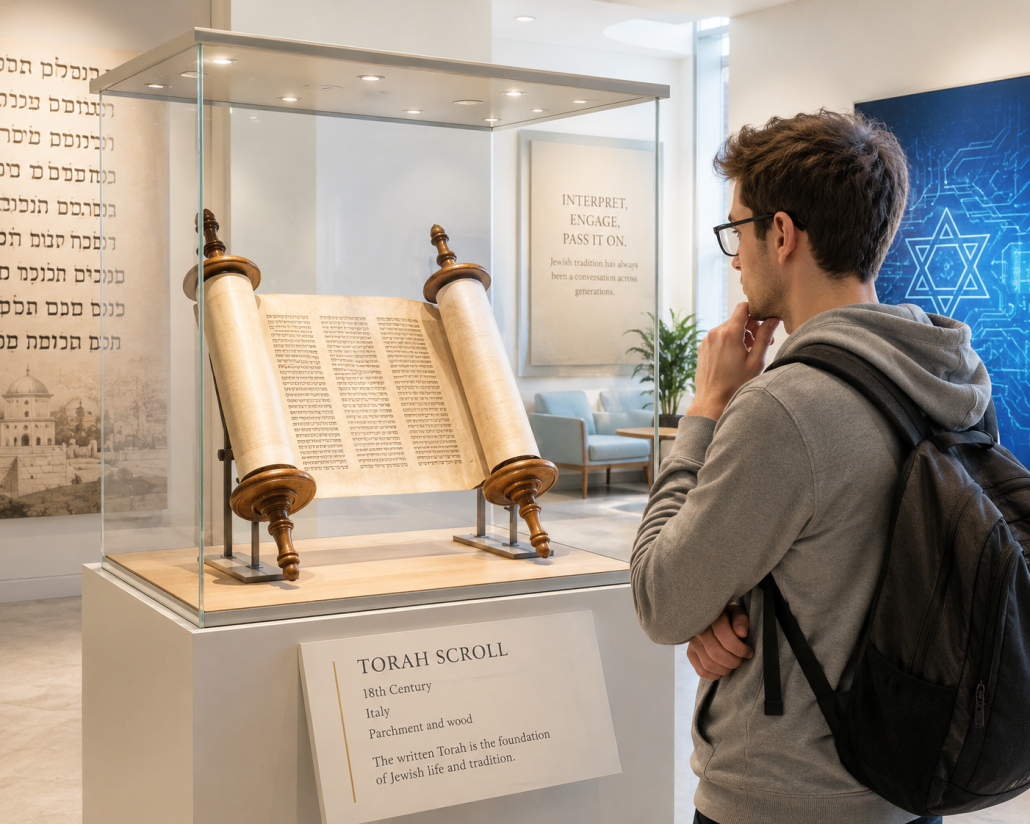
Torah does not belong under glass. Museums put precious things under glass. We preserve them, protect them from human hands, and admire them as treasures from another time. That is precisely what we cannot do with Torah. If Torah is going to guide us rather than simply remind us where we came from, we have to hold it in our hands, engage with it, and wrestle with it. And engagement sometimes requires us to reinterpret what it says.
For thousands of years, Jews have carried the same sacred text into worlds its authors could never have imagined. Empires rose and disappeared. Sacrifice gave way to prayer. We moved from farms and villages to cities, from handwritten scrolls to printing presses, from horses to airplanes, and now to artificial intelligence, genetic engineering, and computers that can answer back.
And still we carry Torah, storing it in the ark most days, and walking it around the room on others. We need to take it out for a walk more often.
How can a text written thousands of years ago guide people living in a world its authors could not possibly have anticipated? What do we do when its teachings seem archaic, morally troubling, or simply unworkable?
We could discard it. Or we could do what Jews have been doing for two thousand years: argue with it.
Consider one of the Torah’s more disturbing laws. Deuteronomy describes the ben sorer u’moreh, the wayward and defiant son. He refuses to obey his parents. His parents bring him before the elders and declare that he is “disloyal and defiant,” “a glutton and a drunkard.”
The punishment is horrifying. The people of the town are commanded to stone him to death. Parents have been exasperated by children for as long as there have been parents and children. Children test limits. They ignore us. They make the same mistake immediately after promising never to do it again. And occasionally they inspire parental pronouncements like, “If you don’t clean up these toys, I’m throwing them all away.”
We don’t mean that either. But stoning as a solution?
The rabbis of the Talmud were not prepared simply to erase the passage. It was Torah. Nor were they prepared to carry it out simply because it was Torah. So they did something audacious. They interpreted it almost out of existence.
They piled requirement upon requirement onto the law until they could declare that such a child “never was and never will be.” Problem solved. Nobody gets stoned.
This is more than a clever rabbinic escape hatch. It is a lesson in how Judaism understands sacred text. The rabbis did not preserve Torah by putting it under glass. They preserved Torah by handling it and engaging with it.
They were rooted enough in the sanctity of the text to refuse to throw it away, and confident enough in their own moral responsibility to refuse to read it woodenly. They inherited Torah and then reconstituted its meaning for the world in which they actually lived.
A Judaism severed from Torah may become contemporary, but eventually it ceases to be Judaism. At the same time, we cannot pretend that every command, assumption, social structure, or punishment found in an ancient text can be transplanted literally into the twenty-first century.
Our choices are not limited to obedience or rejection. A third choice exists: interpretation.
Not interpretation by whim. Not each of us deciding that whatever makes us uncomfortable can conveniently be ignored. The rabbis argued in community and across generations. They preserved majority opinions and minority opinions. They established methods and boundaries for interpretation. They understood the process itself to be sacred.
That is the Judaism I want my children to inherit. A Judaism rooted deeply enough in Torah that we do not abandon it when it troubles us, and alive enough that we can wrestle with it when it no longer speaks adequately to the world before us.
We need that kind of Torah now.
Artificial intelligence can tell us how to do things our grandparents could scarcely have imagined. Genetic engineering may allow us to alter life itself. Technology can put nearly all human knowledge into the palm of a child’s hand.
But none of it can tell us what we ought to do.
For that, we need wisdom older than our technology. We need a moral inheritance that does not begin with us. We need stories, obligations, arguments, failures, commandments, and aspirations tested against human experience for generations.
We need Torah. Not a Torah locked away because we are afraid to disturb it. Not a Torah displayed under glass because we confuse preservation with reverence. And not a Torah rewritten every time modernity changes its mind.
We need the Torah Jews have always had: ancient and evolving, sacred and argued over, inherited and reinterpreted.
Torah does not belong under glass. It belongs in our hands.
Rabbi Evan J. Krame
If this reflection resonates with you, consider sharing it on social media—or simply take a moment to reflect on how you can create a better community.