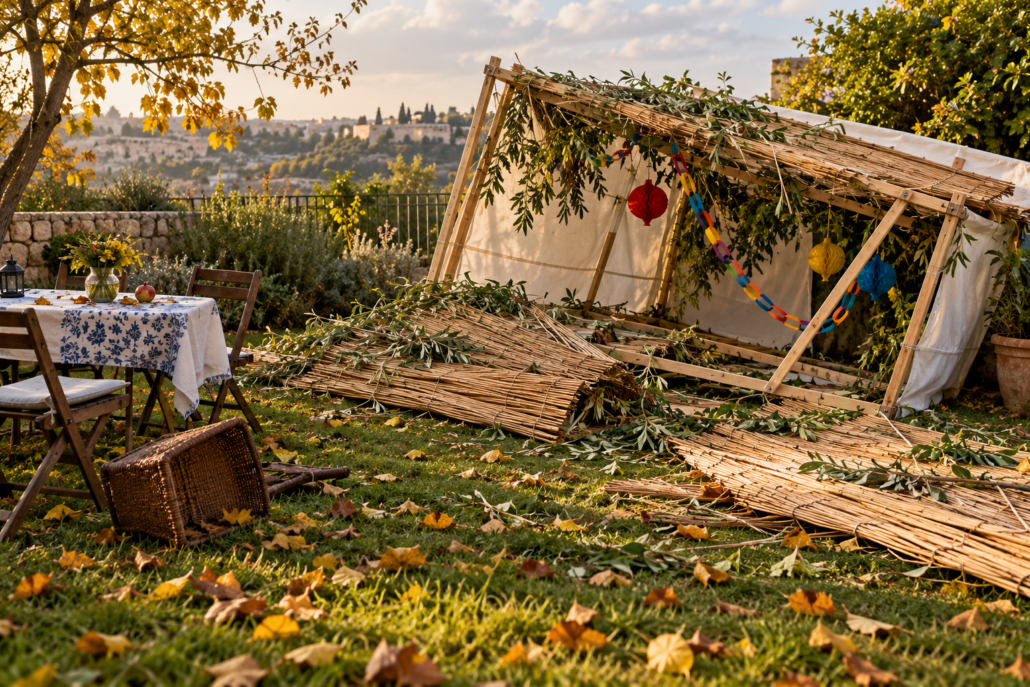
This weekend’s nor’easter, churning up the East Coast, took me back to another September storm in Potomac. The canvas sides of our wood-framed sukkah caught the wind like sails. The whole thing toppled onto its side. The schach, the branches we had so carefully laid across the top, scattered across the yard.
Our sukkah held the holiday’s lesson. Occasionally, we get knocked down by life’s wind gusts. The point isn’t the falling. It’s the getting up.
Raising the fallen sukkah
After a meal in the Sukkah, the blessings include an extra line: Harachaman hu yakim lanu et sukkat David hanofelet. May the Merciful One raise up for us the fallen sukkah of David. The words come from the prophet Amos, who saw a kingdom in ruins and promised that its breaches would be repaired and it would be rebuilt as in days of old.
Notice what Amos does not promise. He doesn’t say the sukkah will never fall. He takes the fall as a given. His promise is about the rebuilding.
Proverbs put it more bluntly: the righteous fall seven times and rise again. The righteous aren’t defined by staying upright. They’re defined by rising.
Build it again, build it wiser
Getting back on our feet is only part of the work. The other part is figuring out why we fell. After our sukkah went down, I reconsidered the structure and hoped for calmer weather. Should I have tethered it? What about weighting the corners? Could I have tightened the canvas so it wouldn’t act like a sail?
Life’s knockdowns invite the same inspection. We can return to the design. We can find the flaws. And we can steady our steps before the next storm, because there will be another.
On Sukkot we read Kohelet, which reminds us there is a time to tear down and a time to build up. Both are seasons. Neither is permanent.
A confession
This isn’t my audition for a career as a social media life coach. I know too well the grief that follows a setback, a loss, a door closing. I’m no expert at getting back up. I’ve logged more hours than I care to admit dwelling on regrets and wallowing in loss. I’ve felt knocked down by the loss of a friendship and a partner’s departure. I have wallowed in that grief, knocked down in grief longer than I imagine is healthy.
But the Sukkot holiday doesn’t ask us to pretend the wind won’t blow again or that disappointments won’t plague us again. It asks us to go outside anyway.
Joy in a shaky shelter
Here is the paradox of Sukkot. We call it z’man simchateinu, the season of our joy, and we celebrate it in the most precarious setting on the Jewish calendar. We leave our sturdy homes for a hut with a leaky roof. The schach must be sparse enough to see the stars through it. We decorate knowing the rain may soak the paper chains, the squirrels may raid the gourds, and the wind may topple it all.
And still, we gather. We invite family and friends. We shiver through a chilly evening and appreciate the kitchen’s warmth a little more. The fragility doesn’t diminish the joy. It sharpens it.
The sukkah teaches that we don’t need permanence to be happy. We need enough shelter over us, the right people in our lives, and the will to rebuild when the storm passes.
May the One who supports the fallen, somech noflim, lift us when we stumble. May we rebuild with more wisdom than we had before. And may we find joy, even under a roof full of holes, because we can see the stars shining through.
Chag sameach.
Rabbi Evan J. Krame
If this reflection resonates with you, consider sharing it on social media—or simply take a moment to reflect on how you can create a better community.